
Sidebar
Resources I use:
- Liberation Toolbox by YK Hong (paywalled site)
- Where's Your Ed At by Ed Zitron
- Pluralistic by Cory Doctorow
- Addie LaMarr on Instagram and YouTube
- Good Work by Dan Toomey and Morning Brew
- 404 Media
- Casual Finance on YouTube and Instagram
- Simon Willison's Weblog
Posts tagged with "projects"
Out, damned WordPress!
2026-08-10 / tags: ai, housekeeping, projects, quick reads, security, sidebar updates

Scenes from my inbox over the past month:
July 10th: [Constance Bello's Blog] Your site has been updated to WordPress 7.0.1
July 17th: [Constance Bello's Blog] Your site has been updated to WordPress 7.0.2
August 6th: [Constance Bello's Blog] Your site has been updated to WordPress 7.0.3
I had my blog running on a managed WordPress site run by May First, a technology cooperative I'm a member of – and their staff have been busy. I'm far from the only person having to deal with frequent updates for my software of late. And WordPress is far from the only affected software. Though 7.0.1 was a maintenance release to follow up on non-security bugs from 7.0 a month and a half prior, 7.0.2 and 7.0.3 fixed critical- and high-severity security bugs that are being discovered at a rapid clip thanks to advances in frontier LLM capability combined with more and more researchers pointing them at software projects, intentionally or not[1]. You may have noticed that your operating system, web browser, or other important software has been needing updates more than usual lately – this is why.
The most secure code is the code that never runs, so I've decided to switch to a static site generator-based website. Instead of a WordPress process running on a server at all times to give you access to my posts, this setup spits out a folder that contains static files that make up the website, which can be served by a variety of service providers and HTTP servers with ease. This trades off a bit of functionality for users (like the ability to comment on posts and subscribe to a mailing list without going to another website) with lots of upside for all parties (better security and a more privacy-respecting posture for users, and the same for me, plus less maintenance overhead and more customizability). If you're interested in all the gory details, I might put out a technical writeup at some point, but for now feel free to look at a mirror of the code.
Personally, my life has been a hot mess the past couple months, between moving (twice... ask me about my Airbnb experience when I was between apartments) and continuing to look for work. I've only recently had time to settle back into projects and getting back to the blog was on top of the proverbial priority queue. I'm bundling that with an update to my #branding; that logo in the top left of the screen[2] is also in my wallet now!

I'm looking forward to giving some of these out at the New Yorker Hotel, where I'll be next weekend for HOPE!
And, as per usual, sidebar additions:
- The Casual Finance YouTube channel tackles the AI bubble from an economics perspective, explaining how fucked everything is in the ✨capital markets✨ that allocate resources in the systems we exist within.
- Simon Willison's Weblog has lots of insights on the day-to-day use of LLMs for software engineering. I resisted for a long time, but I finally bit the bullet and started using LLMs in a very limited way for my projects, with Zed's built-in AI features hooked up to Ollama running models locally. This way, I won't need to worry about what might happen to my model access when the bottom falls out from under OpenAI and Anthropic, since I'm not using any of their tech anyway, and by using open weight models I'm not propping up their business model predicated on extraction.
Until next time, friends...
-
OpenAI was training a model for an internal-only research prototype when it popped open Hugging Face, a platform where users share AI models and datasets, by finding and exploiting multiple zero-day vulnerabilities in software OpenAI's systems use. They held a last-minute talk at Black Hat USA this past Wednesday to disclose some juicy new details (YouTube link) that I haven't had a chance to review yet. ↩
-
It's a bit shy on mobile so the layout can work better. Sorry! ↩
Introducing identity-spinner
2026-06-11 / updated 2026-06-17 / tags: privacy, projects, quick reads, sidebar updates

Advertising. None of us ever agreed to it. We all hate it. Yet since the Internet established itself as the most dominant technological force since electrical grids, advertising has managed to thrust its tendrils into every possible space you could think of, and many, many more you couldn't. Far from a benign infection, its negative effects on people are thorough and wide-ranging.
If you've ever signed up for a hot new app for selling your used clothes, a multiplayer online role-playing game, or any connected service in between, you were asked for some information. Username, date of birth, email address, and often even more identifying info is demanded as the price of entry. Culturally, we are so used to giving up this information over the Internet that we do it without hesitation. Besides, what else are we going to do – lie?
Well, yes, we're going to lie. Introducing identity-spinner.
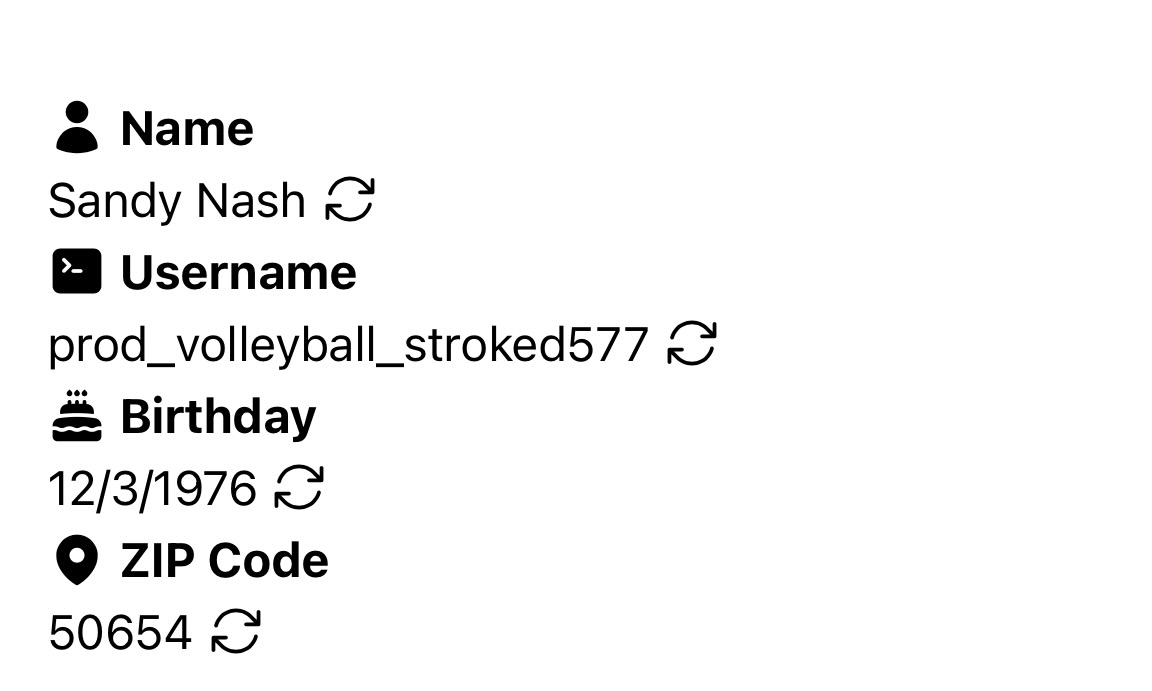
identity-spinner is a really simple tool designed for lying. More specifically, it takes info from reliable data sources and uses it to generate realistic data for fake people to be given to online services for account signups. Or for anything you want, really![1] The README will give you a rundown of exactly where that information is sourced, and the top of it links to the live app where you can experiment.
As is written in that document (and copied to a slot in the app itself), information gathered by advertisers from your devices can reveal a lot about you. Here's some examples of where that information ends up...
- Target figured out a teenager was pregnant before her dad did, sending her coupons for baby clothes.
- Chatrie v. United States, currently being considered by the Supreme Court, has massive implications for whether geofence warrants violate the 4th Amendment. In this case, a criminal conviction was secured on the basis of information found when law enforcement demanded Google fork over info on anyone whose phone reported being near the crime scene around the time it occurred.
- ICE bought access to a tool that tracks location data from hundreds of millions of phones many times a day.
If you thought that adtech data collection wasn't a serious and potentially life-threatening concern when you opened this blog post, hopefully these three examples have shown that the impacts of data leakage are real, physical, and sometimes brutal.
But here's the neat part: A lot of that data is voluntarily given. We can still push back against the normalization of giving away our data. I created identity-spinner because I knew all of this bad stuff was happening and wanted to be more secure with my online activity, but coming up with new names, usernames, and birthdays on the spot is hard, since humans aren't random.
From what I know of all the people who don't get so far as setting up a password manager, most folks find keeping themselves secure to be more trouble than it's worth. I really want to lower the barrier to entry and make myself and everyone around me as secure as possible with as little pain as possible, and education (like this blog post) and tooling (like identity-spinner) are two main angles I'm approaching it with.
I've been working on this a bit and have some more features coming down the pike, with a focus on things that are actually useful, like more types of personal info and being able to load the app offline. In the meantime, I'm very curious to hear your thoughts... from whatever moniker!
I would be remiss if I didn't mention that I've added 404 Media to my sidebar[2]. Their journalism has inspired much of my strategizing and they deserve lots more attention and praise than they get right now. If you have the means, consider joining their paid subscription, which gets you lots of cool perks like access to their "FOIA Forum" on top of unrestricted viewing of some of their biggest stories.
Note 6/17/2026: This post initially stated the conviction related to the Chatrie v. United States suit was related to a "violent crime", which is a mischaracterization. I have corrected the error and sincerely apologize for framing the incident as such.
-
Someone I know likes to give fake names when picking up food and other goods, bought with cash... ↩
-
The sidebar can be viewed on top of the feed, on the right (on mobile, it's above the feed). ↩