
Sidebar
Resources I use:
- Liberation Toolbox by YK Hong (paywalled site)
- Where's Your Ed At by Ed Zitron
- Pluralistic by Cory Doctorow
- Addie LaMarr on Instagram and YouTube
- Good Work by Dan Toomey and Morning Brew
- 404 Media
- Casual Finance on YouTube and Instagram
- Simon Willison's Weblog
Posts tagged with "privacy"
Privacy frontends: Eat cake without showing ID
2026-09-17 / tags: big tech, guides, meta, privacy, social media, spacexai

Just here to find a privacy frontend? Jump to the list of services.
Ever heard the phrase "have your cake and eat it too"? Social media companies love doing this. Thoroughly enshittified platforms like Reddit, YouTube, and Instagram gathered goodwill by offering a fun product to the public for free, then they leveraged the critical mass of people they attracted to shove ads down their throats once they were too locked-in[1] with network effects to want to leave. Any time you browse a social media site, or especially a mobile app installed on your phone, these companies are collecting thousands upon thousands of valuable data points to construct a profile of who you are that they can sell to advertisers, whether or not you're logged in to an account.
Never let it be said that I begrudge people their choice of digital junk food. Today I will show you how to doomscroll without giving away your data.
Enter privacy frontends
Privacy frontends are a unique adversarial tool in the fight against big tech. They are web applications that access centralized social media services on behalf of users who want to avoid trackers and bloatware as they watch cat videos or peruse dank memes. In addition to avoiding data collection, users benefit from lighter resource usage and, much of the time, fewer technical issues. The downsides are that this tech goes directly against social media companies' business model, so they have a big incentive to go after them with whatever tactics they can, whether it's changing their code to be more difficult to work around or filing legal challenges, as X is repeatedly attempting with the Nitter project, to varying degrees of success (shout out to the Nitter project for refusing to take these attacks lying down).
Because of the adversarial nature of these projects, they are hosted in a decentralized manner in multiple instances. In computer[2], an "instance" is jargon for an item that does the same thing as other items like it, as defined by its "parent", which it inherits from. In practice, this means that you'll need to find a list of instances for a particular privacy frontend you want to use, and pick from them depending on which is currently accessible, and any other criteria you'd like, such as where the server is located. Then, just navigate to that instance's URL in your web browser, and go bananas. A well maintained privacy frontend will have a list of instances available as part of its code repository, with a pointer to that list in the README (front page).
From there, you can use the frontend as a web application, starting from the home page and going where you'd like; or, you can find a link to the original social media site, copy the path (everything after the top-level domain, usually .com, including the first slash), and paste it at the end of the URL of the frontend's homepage.
Just as a quick demonstration, let's say I got a link from my buddy of an unfortunate typo someone made as they were getting mercilessly slaughtered online:
https://www.reddit.com/r/2007scape/comments/zdo61b/killed_this_noob_at_chaos_elemental_today_pleae/
I definitely want to see what's going on there, but I don't want to give Reddit my birthday, social security, and first born child for the privilege. What's a girl to do? I'll have a list of projects for various services at the end of this post, but we can start with a privacy frontend for Reddit called Redlib. That page shows its README, which has a link to their instance list. I'm in the US, so I'll pick one of the US based ones, https://redlib.catsarch.com. Now I'll just copy the path from my original link (remember, this is everything after the top-level domain, usually .com, including the first slash) and paste it at the end of this one to get:
Now I can view this extremely embarrassing moment of some random gamer's career, enshrined in history, without giving up my identity. Pretty neat! Note also that many of these services have instances accessible via Tor hidden services, I2P, and Yggdrasil for extra layers of protection.
List of services
I'll try to keep this section reasonably up to date with new info, but I can't promise that it will be current at all times. That being said, if you know of something that currently works for a major social media site, is actively maintained, and isn't listed here (or if something listed here is broken), feel free to drop me a line!
- Gelbooru: Gelbooru-Go (instances)
- Reddit: Redlib (instances)
- Imgur: Rimgo (instances)
- Instagram: Kittygram (instances)
- Tenor: Mezzo (instances)
- YouTube: Invidious (instances)
-
Not to be confused with the type of "locked in" I am when I'm writing this blog after my second La Colombe latte of the day. 190mg caffeine each btw. ↩
-
Someone recently called my field by this term without a second word attached and honestly, I'm here for it. Besides, I'm good at all of computer, not just the science. ↩
Introducing identity-spinner
2026-06-11 / updated 2026-06-17 / tags: privacy, projects, quick reads, sidebar updates

Advertising. None of us ever agreed to it. We all hate it. Yet since the Internet established itself as the most dominant technological force since electrical grids, advertising has managed to thrust its tendrils into every possible space you could think of, and many, many more you couldn't. Far from a benign infection, its negative effects on people are thorough and wide-ranging.
If you've ever signed up for a hot new app for selling your used clothes, a multiplayer online role-playing game, or any connected service in between, you were asked for some information. Username, date of birth, email address, and often even more identifying info is demanded as the price of entry. Culturally, we are so used to giving up this information over the Internet that we do it without hesitation. Besides, what else are we going to do – lie?
Well, yes, we're going to lie. Introducing identity-spinner.
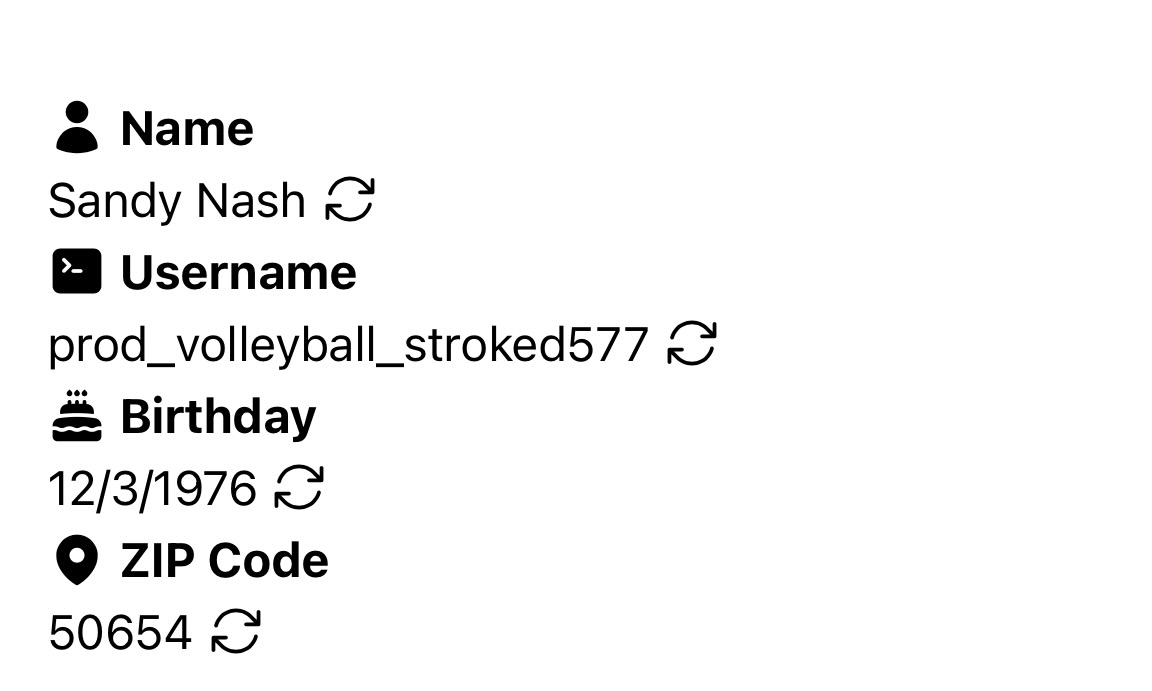
identity-spinner is a really simple tool designed for lying. More specifically, it takes info from reliable data sources and uses it to generate realistic data for fake people to be given to online services for account signups. Or for anything you want, really![1] The README will give you a rundown of exactly where that information is sourced, and the top of it links to the live app where you can experiment.
As is written in that document (and copied to a slot in the app itself), information gathered by advertisers from your devices can reveal a lot about you. Here's some examples of where that information ends up...
- Target figured out a teenager was pregnant before her dad did, sending her coupons for baby clothes.
- Chatrie v. United States, currently being considered by the Supreme Court, has massive implications for whether geofence warrants violate the 4th Amendment. In this case, a criminal conviction was secured on the basis of information found when law enforcement demanded Google fork over info on anyone whose phone reported being near the crime scene around the time it occurred.
- ICE bought access to a tool that tracks location data from hundreds of millions of phones many times a day.
If you thought that adtech data collection wasn't a serious and potentially life-threatening concern when you opened this blog post, hopefully these three examples have shown that the impacts of data leakage are real, physical, and sometimes brutal.
But here's the neat part: A lot of that data is voluntarily given. We can still push back against the normalization of giving away our data. I created identity-spinner because I knew all of this bad stuff was happening and wanted to be more secure with my online activity, but coming up with new names, usernames, and birthdays on the spot is hard, since humans aren't random.
From what I know of all the people who don't get so far as setting up a password manager, most folks find keeping themselves secure to be more trouble than it's worth. I really want to lower the barrier to entry and make myself and everyone around me as secure as possible with as little pain as possible, and education (like this blog post) and tooling (like identity-spinner) are two main angles I'm approaching it with.
I've been working on this a bit and have some more features coming down the pike, with a focus on things that are actually useful, like more types of personal info and being able to load the app offline. In the meantime, I'm very curious to hear your thoughts... from whatever moniker!
I would be remiss if I didn't mention that I've added 404 Media to my sidebar[2]. Their journalism has inspired much of my strategizing and they deserve lots more attention and praise than they get right now. If you have the means, consider joining their paid subscription, which gets you lots of cool perks like access to their "FOIA Forum" on top of unrestricted viewing of some of their biggest stories.
Note 6/17/2026: This post initially stated the conviction related to the Chatrie v. United States suit was related to a "violent crime", which is a mischaracterization. I have corrected the error and sincerely apologize for framing the incident as such.
-
Someone I know likes to give fake names when picking up food and other goods, bought with cash... ↩
-
The sidebar can be viewed on top of the feed, on the right (on mobile, it's above the feed). ↩